When most Malaysians hear the word “omega”, omega-3 usually takes centre stage. EPA and DHA deserve their reputation—but they are only part of a much larger lipid story.
A salmon does not contain one isolated fatty acid. Its oil is a naturally organised matrix of polyunsaturated and monounsaturated fats, each with a different structure and biological role. That is why a full-spectrum salmon oil asks a more interesting question than “How much EPA and DHA is in the capsule?” It asks: what range of fatty acids has been preserved, in what form, and with what proof of origin?
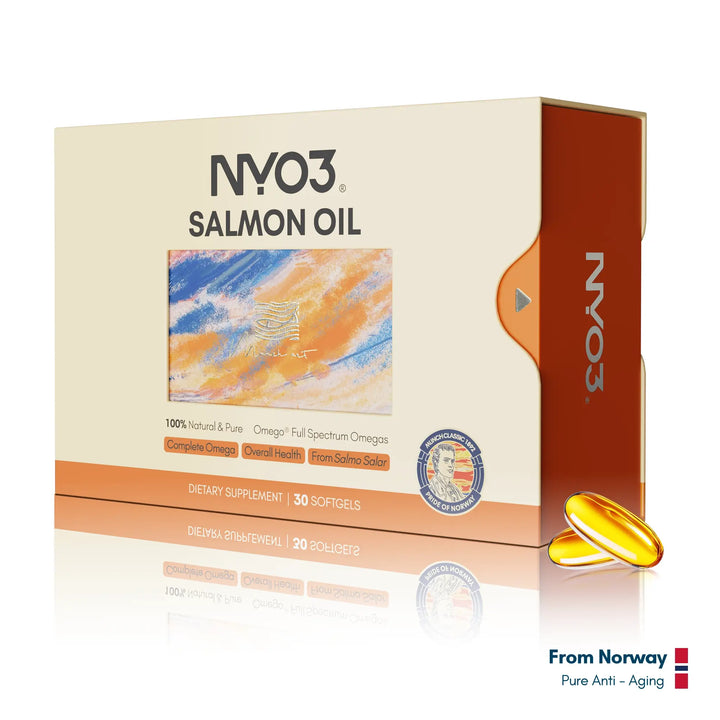
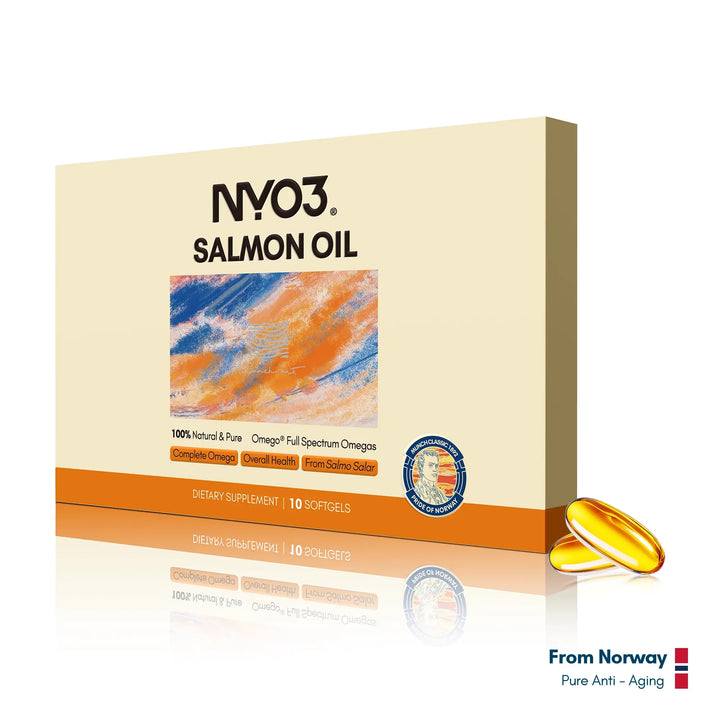
NYO3® Norwegian Salmon Oil is built around that wider view. Each softgel supplies 1,000 mg of salmon oil and declares omega-3, omega-6, omega-7, omega-9 and omega-11 on its label. Independent ORIVO verification, test number 1423, additionally confirms the presence of omega-5—giving the oil six verified omega families in total: 3, 5, 6, 7, 9 and 11.
This guide explains what those numbers actually mean, why the individual families are biologically distinct, and why retaining a broader salmon lipid matrix can be a compelling choice for everyday nutrition.
First things first: an omega number is an address, not a ranking
Every fatty acid is a chain of carbon atoms. Scientists can describe that chain from either end. The “omega” number tells us where the first carbon-to-carbon double bond appears when counting from the methyl—or omega—end.
-
In an omega-3 fatty acid, the first double bond is at carbon 3.
-
In an omega-6 fatty acid, it is at carbon 6.
-
In an omega-9 fatty acid, it is at carbon 9.
So omega-11 is not “better” than omega-9, and omega-3 is not a third-place nutrient. The number is simply a molecular address. The US National Institutes of Health omega-3 fact sheet offers a useful technical overview of this naming system.
There is another layer: an omega family may contain several individual fatty acids. Omega-3, for example, includes ALA, EPA, DHA and DPA. They share the same omega address, but their chain lengths and number of double bonds differ—so their behaviour in membranes and metabolic pathways differs too.
That is also what “full spectrum” means in this article. It does not mean every theoretically possible omega number. It means the six omega families verified in this particular salmon oil: omega-3, 5, 6, 7, 9 and 11.

Why the body works with a network of fatty acids
Fatty acids do far more than store energy. At least three layers of biology are involved:
-
Structure: Fatty acids are incorporated into the phospholipids that form cell membranes. Their chain length and degree of unsaturation influence membrane organisation and fluidity.
-
Communication: Certain fatty acids become starting materials for signalling molecules that help coordinate vascular, immune and inflammatory responses.
-
Metabolism: Fatty acids interact with enzymes, receptors and gene-regulating pathways involved in lipid handling, energy use and cellular adaptation.
This is why “inflammatory balance” is more sophisticated than switching inflammation on or off. A healthy response has an initiation phase and an active resolution phase. EPA, DHA and DPA can give rise to specialised pro-resolving mediators—including resolvins, protectins and maresins—that help guide this return to balance. A scientific review in Biochimica et Biophysica Acta explores these pathways in detail.
The practical takeaway is simple: different fatty acids can contribute in different ways. A broad salmon-oil profile therefore offers a “team” of lipids rather than reducing the entire conversation to one number on the front of a bottle.
The full-spectrum omega map
| Omega family | Representative fatty acids | Why scientists are interested | What NYO3 declares or verifies per softgel |
|---|---|---|---|
| Omega-3 | EPA, DHA, DPA; also ALA in plant foods | Cell membranes, brain and retinal structure, cardiovascular physiology, immune signalling and resolution pathways | 161 mg total, including DHA 35 mg, EPA 23 mg and DPA 12 mg |
| Omega-5 | In marine lipids, commonly myristoleic acid; punicic acid is a different omega-5 found in pomegranate seed | Emerging research into cell signalling and tissue biology | Presence independently verified by ORIVO; not separately itemised in mg on the retail label |
| Omega-6 | Linoleic acid and its longer-chain relatives | Essential membrane components and precursors for a wide range of signalling molecules; important to skin and normal physiology | 161 mg |
| Omega-7 | Palmitoleic acid is the best-known example | A monounsaturated “lipokine” studied in metabolic signalling and epithelial or skin-barrier biology | 22 mg |
| Omega-9 | Oleic acid; marine oils may also contain longer-chain omega-9s | Membrane structure, energy metabolism and the wider benefits associated with unsaturated-fat-rich dietary patterns | 403 mg |
| Omega-11 | Marine long-chain monounsaturated fats can include cetoleic acid (C22:1 n-11) | Growing interest in lipid metabolism, the omega-3 index and skin-quality markers | 23 mg total omega-11 |
The table reveals something easy to miss: NYO3 is not simply an omega-3 concentrate with a salmon picture on the pack. It is a salmon oil whose dominant declared family is omega-9, accompanied by equal declared totals of omega-3 and omega-6, plus omega-7, omega-11 and verified omega-5. That pattern is central to its full-spectrum identity.
Omega-3: EPA, DHA and the often-overlooked DPA
Omega-3 is a family, not a single ingredient—and NYO3 names three long-chain members.
EPA: a signalling specialist
Eicosapentaenoic acid, or EPA, can be incorporated into cell membranes and used to generate signalling molecules involved in vascular and immune physiology. It is also a precursor in several resolution pathways. NYO3 provides 23 mg EPA per softgel.
DHA: structural sophistication
Docosahexaenoic acid, or DHA, is highly unsaturated and particularly abundant in the brain and retina. Its structure helps give specialised membranes the physical properties they need. NYO3 provides 35 mg DHA per softgel.
DPA: more than a bridge between EPA and DHA
Docosapentaenoic acid, or DPA, receives less attention on many labels, yet it is biologically intriguing. It can participate in the interconversion network among long-chain omega-3s and also serves as a precursor to its own specialised pro-resolving mediators. Reviews of DPA’s cardiovascular and metabolic biology and its distinct resolution mediators help explain why its explicit presence is a meaningful feature of a whole-salmon profile. NYO3 provides 12 mg DPA per softgel.
Together, the named EPA, DHA and DPA contribute 70 mg, while the label gives 161 mg for the complete omega-3 family. This is a useful lesson in label reading: a family total can encompass a wider set of fatty acids than the best-known members listed beneath it.
Marine long-chain omega-3s also offer a direct nutritional route. The body can convert plant-derived ALA into EPA and DHA, but that conversion is limited; the NIH notes that reported conversion is generally below 15%. Salmon oil therefore brings preformed EPA, DHA and DPA into the daily diet.
Omega-6: an essential partner in the membrane conversation
Omega-6 is sometimes discussed as though it sits on the opposite side of a contest with omega-3. Human biology is more nuanced. Linoleic acid is an essential fatty acid, meaning it must come from the diet. Omega-6 fatty acids contribute to cell membranes, skin-barrier lipids, growth and an extensive family of signalling molecules.
The most useful concept is not fear of one family, but a well-constructed overall pattern with room for both omega-6 and marine omega-3. In a systematic review and meta-analysis of 30 randomised trials involving 1,377 adults, inflammatory markers remained broadly stable as dietary linoleic acid increased—supporting a far more balanced view of this essential fat.
NYO3 declares 161 mg omega-6 and 161 mg omega-3 per softgel. That one-to-one figure is a transparent description of the capsule’s composition, while your total dietary pattern will naturally reflect the many foods you eat throughout the day.
Omega-9: the largest declared omega family in the capsule
At 403 mg per softgel, omega-9 is NYO3’s largest individually declared omega family. Its best-known member is oleic acid, the monounsaturated fat strongly associated with olive oil, although marine oils can contain several omega-9 molecules.
Omega-9 fatty acids contribute to membrane lipids and energy metabolism. Their broader nutritional relevance is also visible in dietary-pattern research. In the large PREDIMED randomised trial, a Mediterranean dietary pattern enriched with extra-virgin olive oil or nuts was associated with fewer major cardiovascular events among people at elevated risk.
That study examined a whole dietary pattern, not a salmon-oil capsule. Its value here is conceptual: monounsaturated fatty acids deserve a place in the omega conversation alongside EPA and DHA. In NYO3, omega-9 also helps express the authentic fatty-acid pattern of salmon rather than an artificially narrowed profile.
Omega-7: a small family with a lively research story
Palmitoleic acid, the best-known omega-7, is a monounsaturated fatty acid sometimes described as a lipokine—a lipid that can participate in communication between tissues. It is found in selected marine oils and has attracted interest in metabolic and skin-barrier research.
A 12-week randomised, double-blind, placebo-controlled study enrolled 90 healthy women and investigated 500 mg of purified palmitoleic acid daily. Researchers reported improvements in skin hydration and transepidermal water loss, two measures related to skin-barrier function.
NYO3 contributes 22 mg of omega-7 within its salmon-oil matrix. The clinical study used a dedicated, higher-dose palmitoleic preparation, while NYO3’s role is to preserve omega-7 as one member of a broader daily lipid spectrum. That distinction makes the research useful for understanding the molecule and the product useful for experiencing it in natural company.
Omega-11: a marine monounsaturated frontier
Omega-11 is less familiar, which is precisely what makes it interesting. In marine oils, the family can include cetoleic acid (C22:1 n-11), a long-chain monounsaturated fatty acid being studied for its interactions with omega-3 metabolism.
In two randomised, double-blind, placebo-controlled pilot studies, a North Atlantic fish oil rich in cetoleic and other long-chain monounsaturated fatty acids was evaluated for the omega-3 index and skin quality. The researchers reported an increase in the omega-3 index that was greater than expected from the oil’s EPA and DHA content alone, together with favourable changes in selected skin measurements.
NYO3 declares 23 mg total omega-11 per softgel. Because a family total can contain more than one individual fatty acid, the label should be read exactly as written: it confirms the omega-11 family, while cetoleic acid provides a scientifically relevant example of the marine molecules found at this omega address.
Omega-5: why the same number can describe different molecules
Omega-5 is a perfect demonstration of why omega numbers are only the first part of a fatty acid’s identity.
Punicic acid from pomegranate seed is often called omega-5, but marine lipid profiles more commonly associate the omega-5 address with myristoleic acid (C14:1 n-5). Both have their first double bond five carbons from the omega end; their chain lengths and total double bonds are different, so they are different molecules.
Myristoleic acid is currently an emerging research subject. For example, laboratory research in human dermal papilla cells reported activation of signalling associated with the anagen—or active growth—phase of the hair cycle. This is mechanistic research, and it gives scientists a promising map for further exploration.
NYO3’s retail label does not assign a separate milligram line to omega-5. Its presence is instead documented through the product’s ORIVO origin certificate, which verifies omega-3, 5, 6, 7, 9 and 11 in the Norwegian salmon oil.
And what about omega-4, omega-8 or omega-10?
The naming system does continue. Omega-10 provides a useful example: sapienic acid is a characteristic fatty acid in human sebum and has its first double bond at the omega-10 position. Other numerical families appear in specialised foods, tissues and biochemical literature.
For a consumer product, however, “full spectrum” is best understood as a verified product profile rather than a claim to contain every omega number. NYO3’s spectrum is clearly defined by the six families identified in its salmon oil: omega-3, 5, 6, 7, 9 and 11.

Why the natural salmon matrix matters
A conventional label comparison often reduces fish oil to EPA plus DHA. Those two molecules are important, but a whole salmon oil contains a more complex context: DPA, several monounsaturated families, accompanying fatty acids and naturally occurring minor compounds.
NYO3 uses OmeGo® salmon oil in its natural triglyceride (nTG) form. In a triglyceride, three fatty acids are attached to a glycerol backbone—the familiar form in which dietary fats naturally occur. The ingredient supplier, Hofseth BioCare, describes a gentle enzymatic process that liberates oil from fresh Norwegian salmon trimmings in under an hour, without a conventional refining process. The intention is to preserve the original food matrix and natural chemical form.
That matrix is now an active clinical research subject. A 2026 randomised, active-controlled, 14-week study assigned 84 healthy adults to OmeGo or a concentrated omega-3 comparator. Although the OmeGo regimen contained 2.5 times less EPA and DHA, the reported rise in the red-blood-cell Omega-3 Index was 1.7 times greater; normalised per 100 mg of EPA plus DHA, the increase was 4.3 times greater. The OmeGo group also showed larger decreases in hsCRP, TNF-α and IL-6, with between-group differences reaching statistical significance for hsCRP and TNF-α.
The study used its own research protocol and OmeGo regimens; it adds valuable evidence to the ingredient story. For everyday use of the finished NYO3 product, the relevant serving remains the one on the pack: one softgel daily, during or immediately after a meal.
Read the NYO3 label like a lipid scientist
Here is the full declared profile per one-softgel serving:
| Label component | Amount per softgel | How to interpret it |
|---|---|---|
| OmeGo® Salmon Oil | 1,000 mg | The complete salmon-oil ingredient |
| Omegas & Saturated Fatty Acid | 970 mg | A combined lipid-profile line; the named omega families sit beneath it |
| Omega-3 | 161 mg | Includes DHA, EPA, DPA and other omega-3s in the family total |
| DHA | 35 mg | A long-chain omega-3 with a strong structural role |
| EPA | 23 mg | A long-chain omega-3 involved in signalling pathways |
| DPA | 12 mg | A long-chain omega-3 with distinct metabolic and resolution pathways |
| Omega-6 | 161 mg | An essential polyunsaturated-fat family |
| Omega-7 | 22 mg | A monounsaturated-fat family commonly associated with palmitoleic acid |
| Omega-9 | 403 mg | The largest declared omega family in the capsule |
| Omega-11 | 23 mg | A marine monounsaturated-fat family |
| Astaxanthin | 7 mcg | A naturally occurring salmon carotenoid |
Omega-5 presence is verified by ORIVO but is not separately quantified on the retail label. Other ingredients are gelatine, glycerine and water, and the product contains fish. Each pack contains 30 softgels.
This precise reading matters. The 970 mg line combines omegas and saturated fatty acids; it should not be confused with 970 mg of omega-3. NYO3’s distinctive value lies in the breadth and integrity of its salmon-oil profile, not in turning every lipid into the same thing.

Why we recommend NYO3 Norwegian Salmon Oil
For someone looking beyond a single headline dose, NYO3 brings together several qualities that make sense as a complete product story.
1. Six verified omega families
Omega-3, 5, 6, 7, 9 and 11 create a genuinely broader fatty-acid profile. The presence of the six families is independently documented by ORIVO rather than resting only on a front-label phrase.
2. EPA, DHA and DPA are all named
DPA is often left out of everyday omega conversations. Seeing it declared alongside EPA and DHA makes the label more informative and better reflects the richness of salmon lipids.
3. Authentic salmon and Norwegian origin are traceable
The product identifies Atlantic salmon (Salmo salar) as its fish source, while ORIVO test 1423 confirms the species as salmon, the origin as Norway and the product as pure Norwegian salmon oil. ORIVO explains that its programme uses laboratory fingerprinting against a reference database and lists verified batches online, giving consumers a practical way to check provenance.
4. The oil remains in a natural triglyceride matrix
Rather than building the formula around isolated fatty-acid numbers, the nTG format retains the glycerol-bound structure familiar to food fats and supports the product’s whole-salmon philosophy.
5. One softgel makes the routine easy
One capsule daily with a meal is straightforward to remember. The product is also labelled as having no fishy aftertaste—an appreciable detail for anyone who wants marine nutrition without carrying the experience through the rest of the day.
How to make full-spectrum omega part of a Malaysian routine
Start with food. Malaysia offers an excellent range of fish—from ikan kembung and sardines to salmon—and the Malaysian Dietary Guidelines 2020 includes local fish in its marine omega-3 tables. A varied diet remains the foundation.
Then think about consistency. Busy weekdays, eating out and changing menus can make marine-fat intake uneven. A daily full-spectrum salmon-oil softgel can provide a simple, measured complement to that food-first pattern.
For NYO3:
-
Take one softgel daily during or immediately after a meal, or follow the guidance of your healthcare professional.
-
Store it in its original sealed packaging in a cool, dry place away from direct sunlight—especially relevant in Malaysia’s warm climate.
-
If you are pregnant, breastfeeding, taking medication or managing a health condition, personalise your routine with a healthcare professional.
For a closer look at EPA and DHA, read our guide to omega-3 benefits and sources in Malaysia. If you are comparing marine-oil formats, our krill oil vs fish oil guide is a useful next step.
Frequently asked questions
Is “omega-11” stronger than “omega-3”?
No ranking is implied. The number identifies the position of the first double bond from the omega end of the fatty-acid chain. Omega-3 and omega-11 are different structural families with different metabolic pathways.
Why include omega-6 in a balanced formula?
Omega-6 is an essential part of human nutrition and contributes to membranes, skin-barrier lipids and signalling pathways. NYO3’s full-spectrum approach recognises omega-6 and omega-3 as members of the same biological network.
Why is omega-9 the largest declared family in NYO3?
Because NYO3 preserves a natural salmon-oil pattern rather than reducing the oil to EPA and DHA alone. The 403 mg omega-9 line is a visible expression of that broader matrix.
Is full-spectrum salmon oil the same as a high-strength omega-3 concentrate?
They serve different nutritional priorities. A concentrate centres on maximising selected fatty acids, usually EPA and DHA. Full-spectrum salmon oil centres on preserving breadth—multiple omega families, DPA and the natural triglyceride matrix. NYO3 is designed for people who value that whole-salmon approach.
What does nTG mean?
nTG means natural triglyceride. Three fatty acids are attached to glycerol, reflecting the structural format naturally found in food fats and fresh salmon oil.
Can a salmon-oil softgel replace eating fish?
Think of it as a complement, not a menu replacement. Fish contributes protein, vitamins, minerals and the pleasure of food; NYO3 offers a convenient and consistent way to add a measured salmon-oil spectrum to your routine.
The final word: move from a single number to a fuller picture
The deepest lesson in omega science is that fatty acids operate as a network. EPA, DHA and DPA bring long-chain omega-3 biology. Omega-6 contributes essential structural and signalling functions. Omega-7 has become an exciting subject in lipid and skin-barrier research. Omega-9 anchors the monounsaturated side of the profile. Omega-11 is opening new lines of marine-lipid research, while omega-5 reminds us how much biochemical detail sits behind a seemingly simple number.
NYO3 Norwegian Salmon Oil packages that broader story into one daily softgel: 1,000 mg of salmon oil, five omega families quantified on the label, a sixth verified by ORIVO, the nTG matrix preserved, and Norwegian salmon origin that can be checked by test number.
If your idea of quality includes breadth, natural structure and traceable origin, this is an omega supplement worth discovering.
Explore NYO3® Norwegian Salmon Oil
This article is for general nutritional education and is not intended to diagnose, treat, cure or prevent any disease. Individual needs vary; consult a qualified healthcare professional for personalised advice.