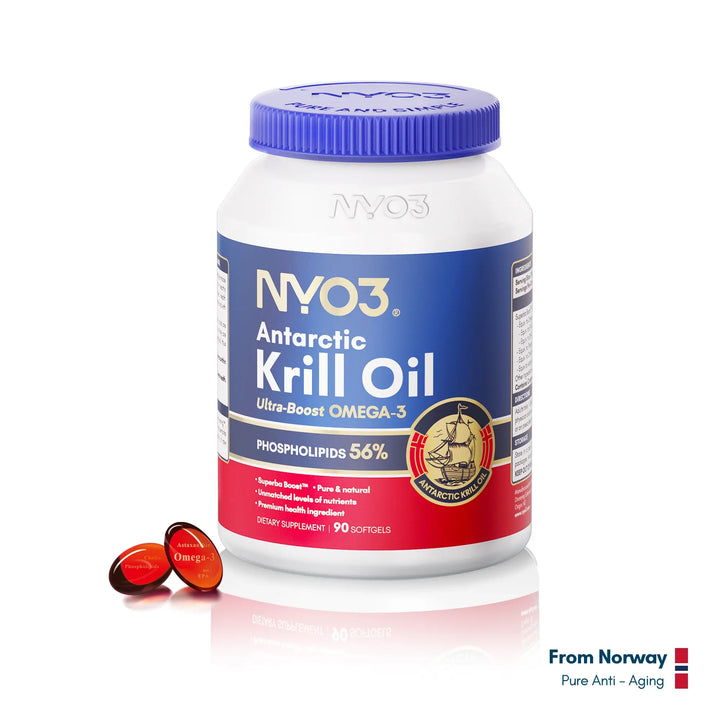
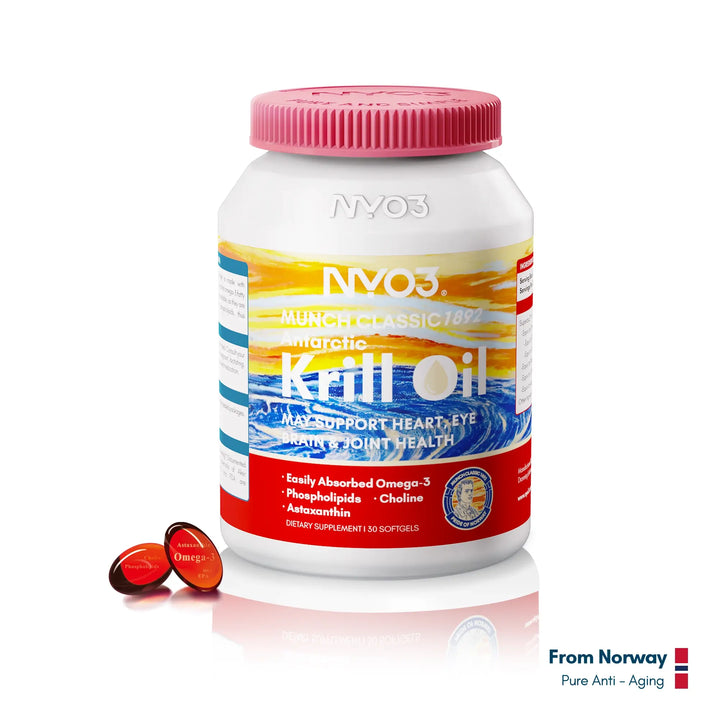
The best time to take krill oil is the meal time you can follow consistently. Morning, lunch, and dinner can all work. The correct serving, however, depends on the exact product. NYO3 56% Phospholipids and NYO3 Advanced MUNCH CLASSIC 1892 2.0 have different nutrient profiles and different label directions, so they should not be treated as interchangeable bottles.
For Malaysian customers choosing between them, the useful decision is not simply morning versus night. It is whether you want the higher declared phospholipid concentration of the 56% formula or the broader MUNCH 2.0 formula with 47% marine phospholipids plus vitamins D3 and K2. Once you choose the product, build the schedule around its latest label.
The short answer
Take krill oil with a meal and follow the directions on the current bottle. Use breakfast if it is dependable, or move the routine to lunch or dinner if those meals are easier to remember. Do not increase the serving to make up for a missed day.
Why meals are the practical anchor
A meal provides a repeatable cue. You do not need to watch the clock or take the softgels at exactly the same minute. Linking the serving to a meal is usually enough to make the routine consistent.
The current NYO3 Malaysia directions for both featured products place them with a meal. The 56% product page advises adults to take one to two softgels daily with a meal, while the MUNCH 2.0 page advises two softgels daily with a meal. Always check the physical bottle because labels and directions can be updated.
Morning lunch or dinner
Breakfast
Breakfast is convenient if you eat at home and already have a morning routine. It may be less reliable for people who leave early, practise intermittent fasting, or often replace breakfast with coffee alone.
Lunch
Lunch works for people with a predictable office or home schedule. Keep the product in its original labelled packaging. Avoid leaving softgels in a parked car, where Malaysian heat can quickly exceed normal room conditions.
Dinner
Dinner is often the most stable family meal and may be the easiest choice for people with rushed mornings. Evening use is not automatically more effective. Its advantage is simply that it may be easier to remember.
Choosing between the 56 percent formula and MUNCH 2.0
|
Feature |
NYO3 56 Percent Phospholipids |
NYO3 MUNCH 2.0 |
|
Main positioning |
Concentrated phospholipid-rich Antarctic krill oil formula |
Broader krill oil formula with added vitamins D3 and K2 |
|
Marine phospholipids |
56 percent |
47 percent |
|
Krill oil source |
Superba Boost from Euphausia superba |
Superba Boost from Euphausia superba |
|
Highlighted components |
Omega-3, EPA and DHA, phospholipids, choline, naturally occurring astaxanthin |
Omega-3, EPA and DHA, phospholipids, choline, astaxanthin, vitamin D3 and vitamin K2 |
|
Current online directions |
Adults take one to two softgels daily with a meal |
Adults take two softgels daily with a meal |
|
Allergen note |
Contains crustacea |
Contains crustacea and soy |
|
Practical fit |
For customers prioritising the highest declared phospholipid concentration in the current range |
For customers who want a wider nutrient profile in one krill oil product |
The table is a product comparison, not a medical recommendation. The better choice depends on the latest label, dietary needs, other supplements, medicines, allergies, and professional advice where relevant. For a broader label checklist, read our guide to choosing krill oil in Malaysia.
Understanding 56 percent marine phospholipids
The 56% figure describes the declared marine phospholipid concentration in the krill oil. It does not mean that 56% of the product is omega-3, and it should not be confused with the total weight of the softgel or capsule shell.
2-softgel amount of 1,000 mg Antarctic krill oil with 560 mg marine phospholipids, 270 mg total omega-3, 70 mg choline, and naturally occurring astaxanthin. This is why the product appeals to customers who want to prioritise the phospholipid portion of the krill oil profile rather than compare products only by total oil weight.
Phospholipids are structural lipids found in cell membranes. In krill oil, part of the EPA and DHA is associated with these phospholipids. Choline is also part of the formula's declared nutrient profile. These components should still be read as parts of one serving, not added together as if they were separate doses. For more background on these nutrients, see our krill oil benefits guide.
What MUNCH 2.0 adds
MUNCH 2.0 declares 47% marine phospholipids and expands the formula with vitamins D3 and K2. Its product page describes eight nutrient types, including the krill oil components and the added vitamins. This makes it a different proposition from the 56% formula rather than a lower-number copy of it.
Customers already using a multivitamin or separate vitamins D or K should compare all labels before combining products. More ingredients do not automatically mean that a product is more suitable for every person. Vitamin K is particularly relevant to medication reviews, so people using anticoagulants should speak with a healthcare professional before starting MUNCH 2.0.
A Malaysia friendly routine
Choose the meal that stays most consistent during your real week, including workdays and weekends. A simple routine may look like this:
- Keep the unopened bottle in a cool dry cupboard away from direct sunlight and cooking heat.
- Take the labelled serving with the same regular meal.
- Use a phone reminder for the first two weeks if you are building a new habit.
- Keep the softgels in their original packaging when travelling so the directions and allergen information remain available.
- Review the bottle label again when you repurchase because product information can change.
During a fasting period, move the serving to a suitable meal within the eating window and continue to follow the product label. Anyone fasting for medical reasons or using medicine that must be timed carefully should ask a healthcare professional for individual guidance.
Storage in a hot and humid climate
Malaysia's heat and humidity make storage part of the routine. Both product pages advise keeping the softgels in the original sealed package in a cool, dry place away from direct sunlight. Do not leave the bottle in a car, beside a cooker, on a sunny windowsill, or in a damp bathroom.
Refrigeration is not a default requirement unless the current label specifically says so. Frequent movement between a cold refrigerator and humid room air can also introduce condensation around packaging. Follow the bottle rather than creating a new storage rule.
Missed servings and travel
If you miss a serving, return to the normal labelled schedule. Do not double the next serving. When flying or crossing time zones, attach the routine to the next suitable meal rather than trying to preserve the exact Malaysian clock time.
Carry only the amount you need, but keep it in clearly labelled original packaging. This is useful for identifying the product and its crustacean or soy allergen information if questions arise during travel.
Who should check before use
Krill belongs to the crustacean group. People with crustacean or shellfish allergies should not assume that a product is suitable simply because it is sold as omega-3. MUNCH 2.0 also carries a soy allergen note on its current product information.
Pregnant or breastfeeding women, people preparing for surgery, those with a medical condition, and anyone taking prescription medicine should ask a qualified healthcare professional before beginning a new supplement. The MUNCH 2.0 page specifically calls out prescribed medicines and anticoagulants such as warfarin.
Frequently asked questions
Is 56 percent phospholipid the same as 56 percent omega 3
No. Marine phospholipids and omega-3 are different label measures. The product information separately declares the phospholipid amount and the total omega-3 amount.
Which product has more phospholipids
The current range declares 56% marine phospholipids for the 56% formula and 47% for MUNCH 2.0. Compare the serving size as well as the percentage before drawing conclusions.
Does MUNCH 2.0 contain vitamins
Yes. Its current formula includes vitamins D3 and K2 in addition to its krill oil nutrient profile. Check other supplements for overlapping ingredients.
Can I take krill oil before breakfast
The featured NYO3 product directions place the serving with a meal. If breakfast is your chosen meal, take it as directed with breakfast rather than creating an empty-stomach routine.
Can I take krill oil at night
Yes, dinner can be a practical anchor. Night use does not have a proven universal advantage over morning use.
Cara makan krill oil yang betul
Ikut arahan pada label produk terkini dan ambil bersama waktu makan yang mudah anda amalkan setiap hari. Jangan gandakan pengambilan jika anda terlupa satu dos. Dapatkan nasihat profesional kesihatan jika anda mengambil ubat, hamil, menyusu, akan menjalani pembedahan atau mempunyai alahan krustasea.
Choose the formula first and the clock second
The best time to take krill oil is the time attached to a dependable meal. The more important choice comes first: the 56% formula for a higher declared marine phospholipid concentration, or MUNCH 2.0 for a broader formula that includes D3 and K2. Read the latest label, use the correct serving, and keep the routine simple enough to repeat.
Compare NYO3 56% Phospholipids and NYO3 Advanced MUNCH CLASSIC 1892 Antarctic Krill Oil 2.0 on the official Malaysia website.
Important information
This article provides general educational information and is not medical advice. Food supplements should not replace a balanced and varied diet. Follow the current product label. Consult a qualified healthcare professional if you are pregnant or breastfeeding, taking medication, preparing for surgery, have a medical condition, or have a crustacean or soy allergy.
References and further reading
- NYO3 Antarctic Krill Oil 56 Percent Phospholipids
- NYO3 Advanced MUNCH CLASSIC 1892 Antarctic Krill Oil 2.0
- How to Choose Krill Oil in Malaysia
- Krill Oil Benefits in Malaysia
- Omega 3 Fatty Acids Fact Sheet for Health Professionals. National Institutes of Health Office of Dietary Supplements